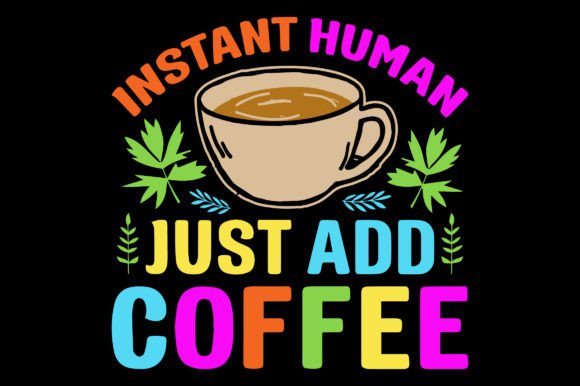
Evaluating Instant Human Just Coffee Sublimation for Embroidery
As a designer who spends more time with stitch angles and backing choices than I care to admit, I see a file like Instant Human Just Coffee Sublimation and immediately picture it on a crisp apron, a lazy Sunday sweatshirt, or a cheeky tote bag that gets a laugh in the checkout line. The name alone tells me this is for the caffeine-dependent crowd—people who run on espresso and dark humor. But how does a graphic originally sold as a T-Shirt Design hold up when you’re thinking with thread, not ink? That’s exactly what I wanted to find out before committing to a client project.
First Impression: A Mood, Not Just a Message
Opening the file, I got a clean, 2000x2000 pixel EPS and a PNG with a transparent background, both at 300 dpi. The artwork isn’t an embroidery file—it’s a fully editable vector in the Graphics category. That means you’ll be digitizing it yourself or passing it to a digitizer, which is standard for most crafters who want total control. The design’s personality hits before you even read the text. There’s a sense of exhausted relatability, the kind that makes a kitchen towel suddenly feel like a safe space. I could already see it in a farmhouse kitchen, on a mug-printed sleeve (yes, I still think in sublimation even when I stitch), or on a narrow pocket patch for a denim shirt.
Visually, the layout feels balanced. The lettering carries the bulk of the message, and if you know anything about embroidery text, you know that’s both a gift and a test. Letterforms that are too thin will vanish under a single pass; too chunky and they turn into blobs on a textured weave. The phrase “Instant Human Just Coffee” has a nice rhythmic cadence, and from a stitching standpoint, that means you can play with fill types without losing readability. I’d likely use a satin stitch for the primary text and reserve a light fill stitch for any accompanying decorative shapes, keeping the overall look sleek but friendly.
Translating a Graphic into Stitches: The Real Work
Let’s be honest—taking a T-Shirt Design meant for sublimation and turning it into a machine embroidery design requires a shift in thinking. Sublimation gives you subtle gradients, soft shadows, and photographic realism. Embroidery demands linework, contrast, and deliberate stitch direction. Instant Human Just Coffee Sublimation is, from what I’m seeing, primarily typographic. That’s actually a relief. Typographic designs tend to transition well because you’re dealing with solid shapes rather than blending or micro-details that puff up under thread.
I’d start by opening the EPS in my digitizing software and converting the text objects to simple closed shapes. The fact that the file is 300 dpi and built in Illustrator CC means the edges are crisp, so manual tracing or auto-detection will work without much cleanup. For the letters, I’d run a medium-density satin column, probably around 0.4 to 0.45mm spacing for a 40-weight thread. If the design includes a small coffee cup icon or steam curves—and many “just coffee” themes do—I’d treat those with a combination of running stitch outlines and light fill to avoid pulling on lighter fabrics like quilting cotton or linen blends.
Because this is a graphic file, not a pre-made embroidery file, you can scale it to fit anything from a 4x4 hoop up to a large 10x14 hoop for jacket backs. Want a tiny version for a baby onesie? You’ll have to simplify. The phrase “Instant Human Just Coffee” loses impact if you shrink it below 2 inches wide—the letters could close up, especially any loops or counters. I’d recommend a minimum width of 3 inches for a text-centric piece like this, which fits comfortably in a standard 5x7 hoop.
Real Project Spotlight: The Coffee-Lover’s Tote Bag
I needed a test case, so I settled on a canvas tote bag for a friend’s small coffee shop. Her customers are primarily bleary-eyed commuters who grin at anything that validates their caffeine habit. I pictured the design stitched in a dark espresso brown thread on an unbleached cotton tote. The plan was simple: digitize the file with a dense but not heavy satin, use a medium-weight cutaway stabilizer, and run a sample on a scrap of similar canvas before the final project.
During the test, I learned exactly what I wanted to share with you. On that slightly nubby surface, the satin stitch held its shape beautifully because I had adjusted the pull compensation in the digitizing software. I also bumped the stitch angle for the larger words to about 15 degrees, which caught the light just enough to make “COFFEE” pop. The finished tote looked intentional and polished—no puckering, no letter distortion. When my friend saw it, she immediately asked if I could do a matching apron and a few embroidered patch versions for her baristas. That’s when I knew the design had real small-batch potential.
Where This Design Shines—and Where You Should Be Cautious
After working with Instant Human Just Coffee Sublimation across a few materials, I compiled a mental list of sweet spots and trouble zones. This isn’t a one-size-fits-all graphic, but it’s surprisingly flexible for the right products.
Ideal for These Embroidery Projects
- Custom apparel: Sweatshirts, unisex tees, hoodies—especially with a contrast thread on a solid background.
- Kitchen textiles: Aprons, tea towels, oven mitts. The coffee theme feels right at home.
- Tote bags and canvas pouches: Easy to hoop, flat surface, big visual payoff.
- Pillow covers: A quirky addition to a reading nook or coffee bar.
- Personalized gifts: Mother’s Day, coworker presents, housewarming gifts for coffee snobs.
- Small shop merchandise: Boutique labels, craft fair staples, Etsy listings tagged with “funny embroidered gift.”
Use with Care or Rethink Entirely
- Stretchy fabric: Jersey and activewear can warp text unless you’re a pro at backing and basting. I’d test on a cotton-poly blend rather than pure performance knit.
- Dark fabrics: If your thread color is close to the fabric, the message disappears. Always check contrast. I printed a one-color paper mockup first to see if the design still read clearly.
- Tiny lettering on curved surfaces: Cap fronts are doable, but reduce the design width significantly and you’ll battle registration. I’d stick to flat areas like cap side panels or visors.
- Thin or sheer fabrics: A chiffon overlay is out of the question. The stitch count will be too heavy even for a lightweight fill.
- Items needing frequent harsh washing: Coffee-themed kitchen towels will be washed a lot. Use polyester thread and a gentle cycle. I’d also avoid soft delicate items where a satin stitch might feel stiff.
The Practical Side: From Screen to Stitch
Before you load Instant Human Just Coffee Sublimation into your shop or your next client project, let’s talk about the stitch-out process. I treat every new design file as a mystery until I’ve run a full test on medium-weight cotton with a medium cutaway stabilizer. Here’s what I’d recommend for this one:
- Digitize carefully: This design arrives as EPS and PNG, not an embroidery file. You or your digitizer will need to map out stitch types, densities, and trims. Programs like Hatch, Wilcom, or even free Ink/Stitch will handle it if you have patience.
- Thread color selection: The mood is casual, so variegated threads or solid earthy tones—coffee brown, cream, charcoal, deep navy—work brilliantly. I’d steer clear of bright neon unless it’s for a party-themed product.
- Stabilizer matters: For a flat item like a tote or apron, a cutaway is non-negotiable. It prevents shifting and keeps the letters crisp even after multiple washes. On a knit sweatshirt, I’d float a sheet of water-soluble topping over the fabric to keep stitches from sinking in.
- Hoop size check: The native graphic is 2000x2000 pixels at 300 dpi, so roughly 6.67 inches square. You can scale down to a 5x7 hoop with zero problem. For a baby bib or a hat patch, resize to about 60% and review the text for any loss of detail.
- Test in black and white: When I’m deciding thread contrast, I convert the design to grayscale on screen. If the text doesn’t stand out, it won’t stitched out on a dark fabric with a dark thread.
- Mockup preview: I always layer the PNG version over a photo of the blank product. Seeing it on a virtual tote or sweatshirt helps clients visualize the finished piece and boosts your Etsy listing quality.
One crucial note for sellers: the product description states it’s a high-quality t-shirt design, but it doesn’t explicitly mention a commercial embroidery license or any file formats beyond EPS and PNG. That’s fine—just be sure you clarify usage rights with the original creator before you sell finished items made with the stitched version, especially if you’re planning on commercial embroidery or offering it as part of a physical product line. Most digital asset shops for crafters allow personal and limited commercial use, but double-checking protects your business.
Will Customers Respond? Yes—If You Frame It Right
From a buyer engagement perspective, Instant Human Just Coffee Sublimation taps into a lifestyle, not just a trend. Coffee culture is ingrained, and the humorous, self-deprecating tone works on everything from a sleepy Sunday morning hoodie to a “world’s okayest barista” apron. When I walked through a local market with the prototype tote, I got multiple comments and even an unsolicited order. That’s the power of a relatable message translated into something tactile and well-made.
For your Etsy seller or small shop product line, this design can anchor a whole collection: coffee-themed tea towels, matching mama-and-baby onesies with “Instant Human” for the parent and “Just Milk” for the infant, or a set of boutique aprons for a pop-up café. It also works as a printable mockup in your digital portfolio if you want to sell the idea without stocking inventory. I’d suggest creating a quick text variation where “COFFEE” is replaced with “TEA” or “CAFFEINE” just to expand the audience without redesigning from scratch. Because the file is editable, you can do that in minutes.
Final Thought Before You Hit the Start Button
I’m not going to tell you every design is a masterpiece out of the virtual box, but Instant Human Just Coffee Sublimation brings a clear, high-impact statement that holds up well when you move from screen to stitch. The fact that it comes as a fully editable vector means you can clean up any element that feels too delicate for thread, and the 2000x2000 resolution gives you plenty of room to scale. Just don’t skip the testing phase, and be thoughtful about your fabric choices. Once you see it embroidered on a soft cotton tee or a rustic kitchen towel, you’ll understand why I’m already planning my next batch.